
Mobile hydraulic equipment often has to deliver substantial force while operating within limited physical space. Manifold systems help organize the hydraulic circuit by bringing valves and internal fluid passages into centralized assemblies.
Instead of routing every connection individually across the machine, the manifold can distribute pressure and return flow close to the equipment being controlled. This can reduce the amount of external hydraulic plumbing required between related components.
Packaging
Compact Hydraulic Control for Mobile Machinery
Space is often limited on mobile equipment because hydraulic components must share the machine with engines, electric drives, frames, operator controls, structural members, attachments, and other systems.
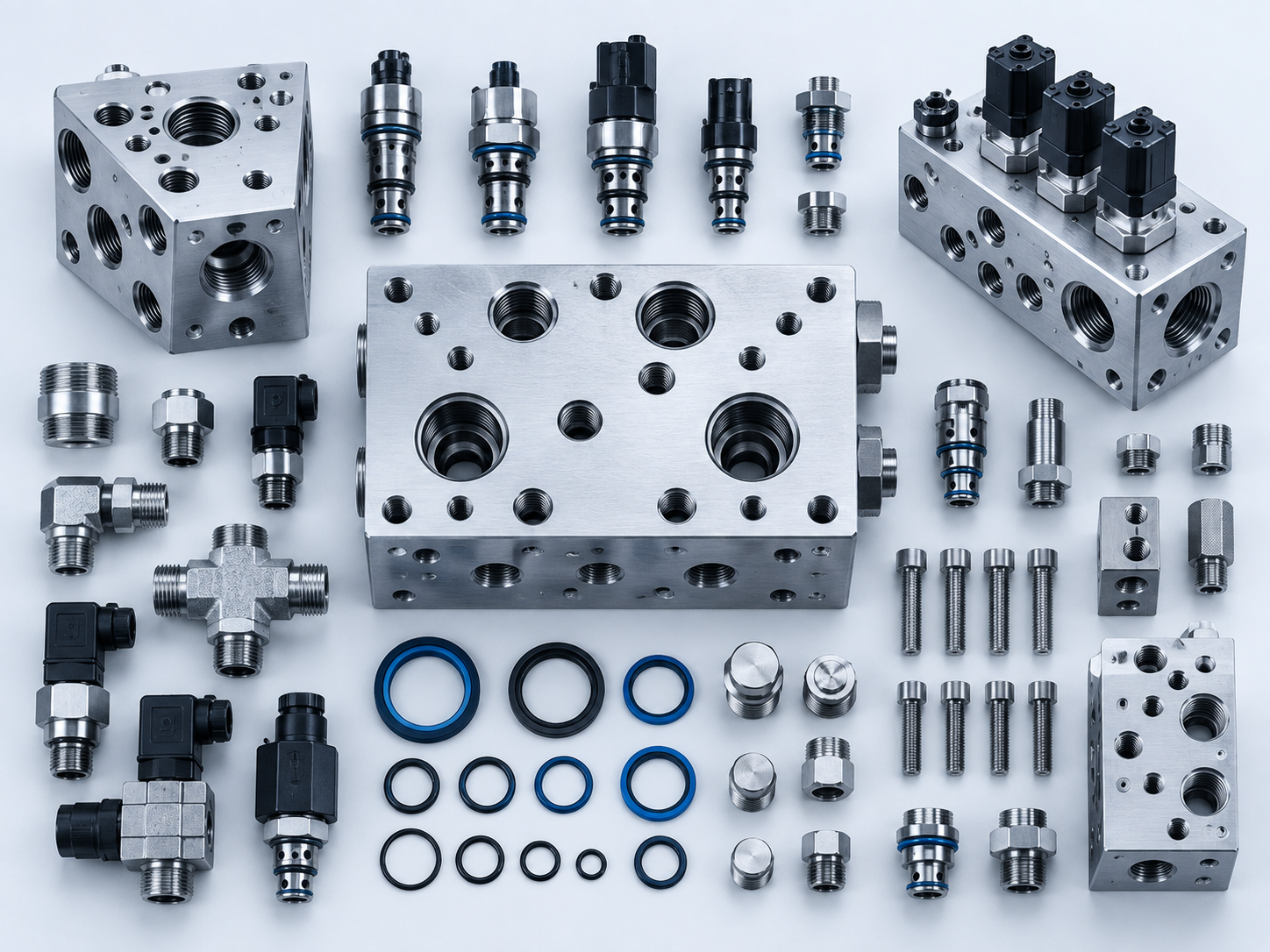
A manifold can place several hydraulic functions into one assembly. Valves can be positioned close to one another while internal passages handle the connections that would otherwise require additional hoses and fittings.

The resulting package can be mounted near cylinders, hydraulic motors, or other operating components, depending on the architecture of the machine.
Hydraulic Components
Pumps, Cylinders and Hydraulic Motors
The manifold operates between the hydraulic power source and the devices performing work. Pumps supply fluid flow, while the manifold's valves determine where that flow is directed.
Mobile equipment commonly uses hydraulic cylinders and hydraulic actuators to create linear movement for lifting, steering, positioning, clamping, tilting, or attachment functions.
Rotary movement can be produced by hydraulic motors. A manifold may route supply and return fluid to these motors while incorporating directional, pressure, and load-control functions.
Load Management
Pressure and Load-Control Functions
Mobile machinery often supports moving loads, suspended equipment, booms, attachments, or other mechanisms where hydraulic pressure must be controlled carefully.
Manifold valves can be arranged to regulate pressure, hold loads, prevent unwanted reverse movement, sequence operations, or limit the pressure available to a particular circuit.
One-way hydraulic control can also involve check valves that allow fluid to move in the intended direction while restricting reverse flow.
Environment
Designing for Mobile Operating Conditions
Mobile equipment may experience vibration, changing temperatures, contamination, moisture, dirt, impact, and repeated movement. Manifold placement and construction should therefore account for the environment surrounding the hydraulic system.
Electrical Control
Solenoid Manifolds in Mobile Equipment
Modern mobile equipment can combine hydraulic power with electronic control. Solenoid-operated valves allow electrical signals from switches, controllers, sensors, or machine electronics to change hydraulic flow paths.
A centralized hydraulic solenoid manifold can control several machine functions while keeping the hydraulic connections organized within one assembly.
Explore Hydraulic Solenoid Manifolds →Applications
Mobile Hydraulic Manifold Applications
Mobile manifold systems can support lifting, steering, attachment movement, material handling, positioning, outriggers, stabilizers, rotating mechanisms, and many other hydraulic functions.
The specific manifold configuration depends on the number of actuators, required flow, system pressure, duty cycle, available space, control method, and operating environment.
Some machines may use one central manifold, while others distribute smaller manifolds near individual machine functions.