
A manifold organizes fluid pathways, but the surrounding components determine where fluid comes from, where it travels, what work it performs, how clean it remains, and how system conditions are measured. Understanding those components is essential when designing or troubleshooting a manifold-based system.
Hydraulic systems may connect pumps, cylinders, motors, filters, pressure-control devices, and reservoirs through one or more manifolds. Pneumatic systems use similar concepts with compressors, air preparation, directional valves, cylinders, tubing, and exhaust connections.
Fluid Power Sources
Pumps and Pressure Generation
Pumps provide fluid flow to hydraulic and process systems. A manifold receives that flow and routes it toward the valves and components that control machine operation.
Industrial hydraulic pumps supply flow to hydraulic circuits in which resistance to movement creates pressure.
Other industrial systems can use centrifugal pumps where the fluid-handling requirements differ from positive-displacement hydraulic circuits.
Linear Motion
Cylinders and Actuators
Actuators convert fluid pressure into mechanical movement. Hydraulic and pneumatic cylinders produce linear motion by applying pressure to a piston inside a barrel.
Manifold valves determine which actuator chamber receives pressurized fluid and where displaced fluid or exhaust air travels during movement.
Hydraulic actuators are one important class of devices connected to manifold-controlled fluid-power circuits.
Cylinders & Actuators →Rotary Motion
Hydraulic Motors
Hydraulic motors convert pressurized fluid energy into rotary mechanical motion.
Directional valves within a manifold can determine motor direction, while pressure and flow-control components can influence torque and speed.
Industrial hydraulic motors are used in many mobile and industrial systems where high-force rotary movement is required.
Hydraulic Motors & Manifolds →Sealing
Seals, O-Rings and Gaskets
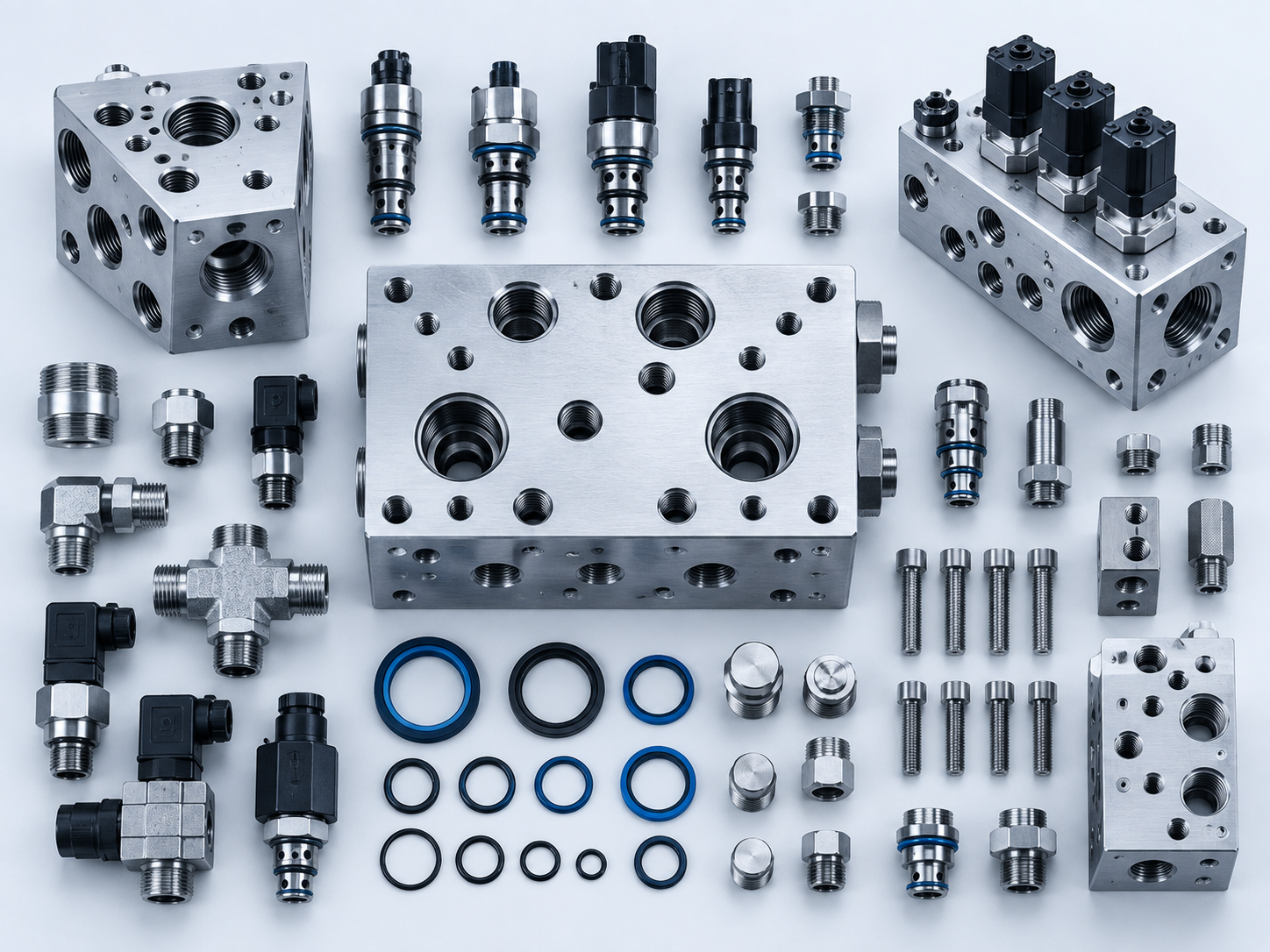
Fluid-control systems depend on seals to prevent leakage between components and between separate passages inside manifold assemblies.
O-rings can seal valve cavities, plugs, fittings, mounting faces, and cartridge components. Gaskets can provide sealing between larger mating surfaces or assemblies.
Seal material should be compatible with the fluid, temperature, pressure, movement, and environmental conditions of the system.
Seals, O-Rings & Gaskets →Contamination Control
Filtration
Contamination can damage pumps, restrict valve movement, wear sealing surfaces, block small orifices, and reduce the reliability of fluid systems.
Filters can be installed upstream or downstream of a manifold depending on the type of system and the contamination-control strategy.
Filtration requirements should consider particle sensitivity, flow rate, pressure drop, fluid type, service intervals, and the components being protected.
Manifold Filtration →Measurement
Flow and Pressure Instrumentation
Sensors and meters help technicians understand what is happening inside a manifold-controlled fluid circuit.
Flow meters can measure the volume or rate of fluid movement, while pressure sensors and gauges provide information about system pressure at selected locations.
Measurement ports can be incorporated directly into manifold blocks so system conditions can be checked close to valves, pumps, and actuators.
Fluid Connections
Hoses, Tubing and Fittings
Manifolds connect to the rest of the system through hoses, tubing, pipe, fittings, adapters, and threaded or flanged ports.
Connection selection influences pressure capability, installation space, flexibility, vibration, maintenance, leakage risk, and system cleanliness.
Port orientation should also provide enough clearance for fittings and tools during assembly and service.
Hoses, Tubing & Fittings →System Integration
Components Must Be Selected as a System
A pump, valve, manifold, actuator, filter, hose, and sensor can each operate correctly on its own while still producing poor results when combined incorrectly.
Flow capacity, pressure, fluid compatibility, response time, heat, contamination sensitivity, fitting size, and component placement should be evaluated across the entire fluid path.