
Even the most compact manifold still needs physical connections to the equipment around it. Those connections must carry the required fluid or gas while tolerating pressure, vibration, movement, temperature, environmental exposure, and maintenance.
Connection design influences both system performance and machine packaging. An undersized line can create pressure loss, while poor routing can make fittings difficult to install or expose hoses to unnecessary bending and abrasion.
Manifold Ports
Connecting External Lines to a Manifold
Manifold ports provide the transition between internal passages and external hoses, tubing, pipe, sensors, valves, gauges, and adapters.
Port design depends on the fitting system, operating pressure, fluid type, available space, sealing method, and expected maintenance.
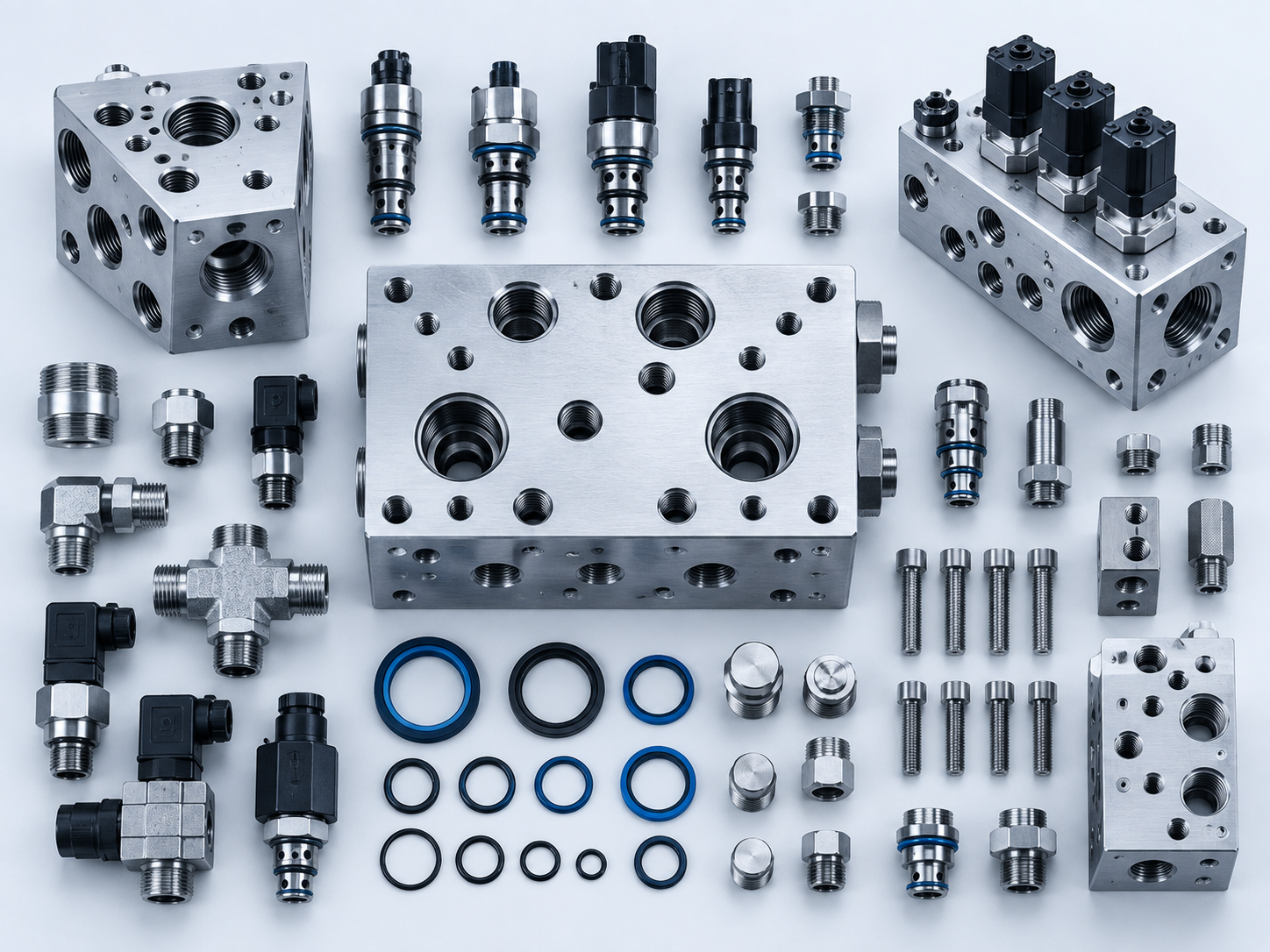
Port orientation can make a major difference in assembly because multiple fittings positioned too close together may interfere with tools, hoses, wiring, or adjacent components.
Flexible Connections
Hoses in Manifold Systems
Flexible hoses are useful where components move, vibration must be accommodated, or rigid tubing would be difficult to route through the machine.
Hose selection should account for pressure, temperature, fluid compatibility, bend radius, abrasion, impulse loading, fitting style, and surrounding environmental conditions.
Equipment such as hose reels can be used in applications where flexible hose must be stored, deployed, and managed repeatedly.
Rigid Connections
Metal Tubing
Rigid metal tubing can provide organized, durable fluid routing between fixed components.
Industrial stainless steel tubing can be considered in systems where corrosion resistance, mechanical durability, or process compatibility are important.
304 stainless steel tubing represents one common stainless material category used across many industrial applications.
Tube outside diameter, wall thickness, fitting style, material, routing, and support should all suit the system requirements.
Pneumatic Tubing
Plastic Tubing for Air and Low-Pressure Systems
Pneumatic systems frequently use flexible polymer tubing because it can be routed easily between manifold valves and actuators.
Industrial plastic tubing is available in many materials and geometries for industrial applications.
Pneumatic tube selection should account for pressure, temperature, bend radius, fitting compatibility, environmental exposure, and the compressed-air requirements of the machine.
Pneumatic Manifolds →Fittings
Fittings, Adapters and Manifold Connections
Fittings join the manifold to hoses, tubing, instruments, valves, and other components.
They can also adapt between different connection sizes, orientations, thread systems, or tube interfaces.
Every added fitting creates another potential restriction and another sealing interface, so compact manifold design often seeks to eliminate unnecessary external connections where practical.

Flow Capacity
Sizing Hoses and Tubing
Line size influences fluid velocity and pressure drop throughout the circuit.
A line that is too restrictive can reduce actuator speed, increase pump load, create pneumatic pressure loss, or contribute to hydraulic heat.
Routing
Hose and Tubing Layout
Lines should be routed so they avoid unnecessary abrasion, sharp bends, hot surfaces, moving mechanisms, and locations where service access is difficult.
Rigid tubing may require clamps or supports to control vibration, while flexible hose should have enough freedom to move without twisting or rubbing against nearby equipment.
Manifold port orientation can simplify this layout by directing connections toward accessible regions of the machine.
Leakage
Connection Sealing and Maintenance
Leaks can develop at damaged hoses, loose fittings, worn seals, improperly assembled connections, cracked tubing, or damaged manifold ports.
Inspection should include both the external line and the sealing interface at the manifold.
Repeated fitting removal can also affect port threads and sealing surfaces over the service life of the component.
Seals, O-Rings & Gaskets →Complete Circuit
Connections Influence Overall System Performance
Manifold passages, valves, hoses, tubes, fittings, filters, meters, pumps, and actuators all form one continuous fluid path.
A well-sized manifold cannot compensate for an external line that is too small, and a large hose cannot eliminate a restriction inside an undersized valve.