
Hydraulic power is used throughout industrial machinery because it can produce controlled force and movement using pumps, valves, cylinders, motors, and related fluid-control components.
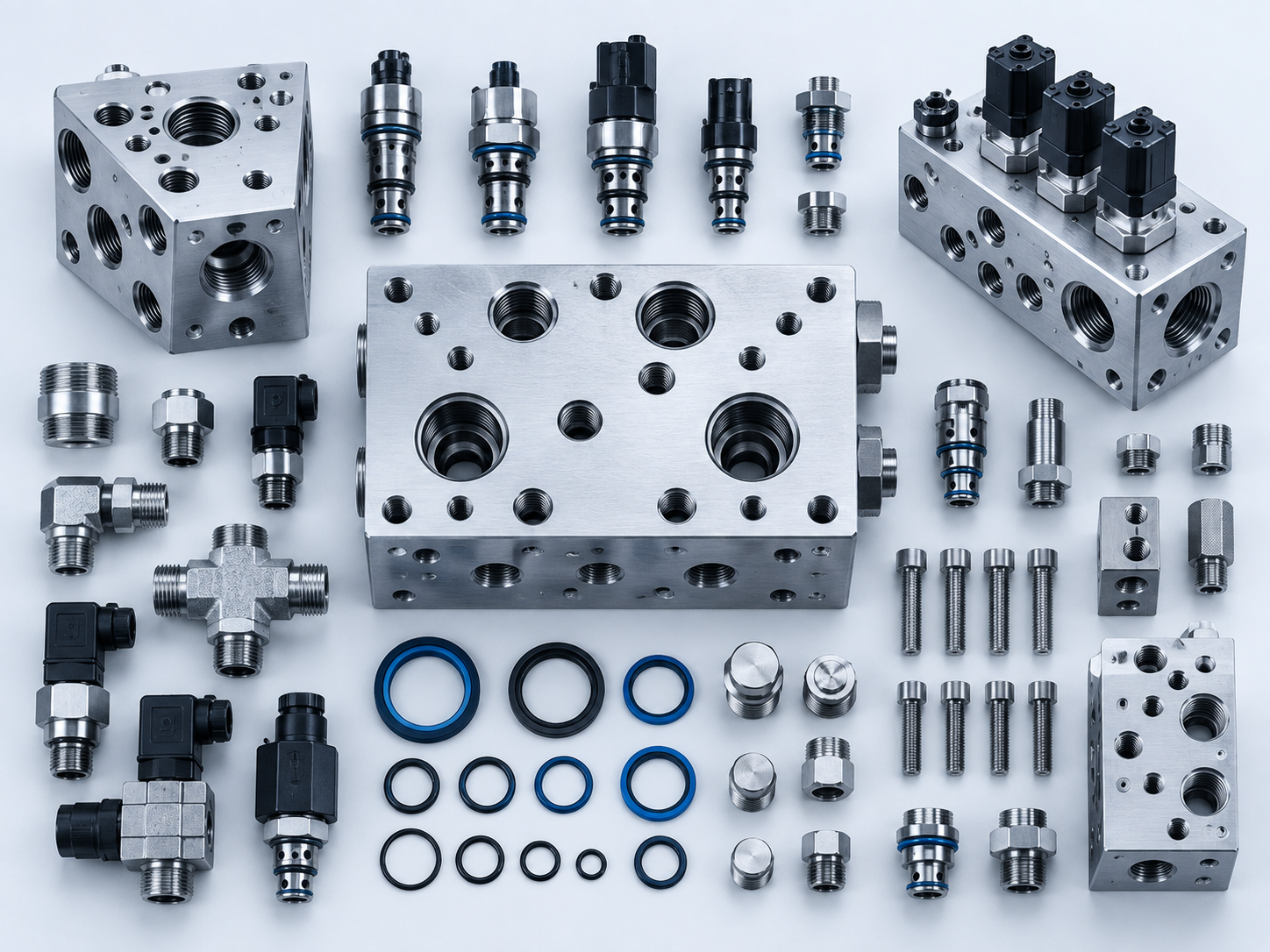
A manifold can act as the central routing and control point for these components. Internal channels move fluid between pressure supply, valves, actuators, instrumentation, and return circuits while reducing the need for separate external connections.
Industrial Equipment
Hydraulic Manifolds in Production Machinery
Production machinery may require several hydraulic functions operating together. Cylinders can clamp parts, move tooling, lift assemblies, position fixtures, or apply controlled force.
Manifolds organize the valves associated with those operations and provide internal connections between the control elements and the actuators they serve.
Equipment using hydraulic presses can depend on hydraulic circuits to generate, control, hold, and release large forces during manufacturing operations.
Actuation
Hydraulic Cylinders and Motors
Linear machine movement is frequently produced by hydraulic cylinders. The manifold directs fluid toward either side of the actuator according to the position of the directional control valve.
Rotary motion can be generated by hydraulic motors when the machine requires continuous rotation rather than linear movement.
Flow rate influences movement speed, while pressure relates to the force or torque available from the actuator. Manifold passages and valves therefore need to support the performance requirements of the equipment.
Automated Control
Manifolds in Automated Machinery
Industrial machinery can combine hydraulic power with electronic automation. Solenoid valves allow controllers to command hydraulic operations according to machine logic, operator inputs, sensors, or programmed sequences.
A manifold can group several electrically operated valves together so multiple hydraulic functions can be coordinated from one assembly.
.png)
Engineering
Industrial Manifold Design Considerations
Pumps & Supply
Connecting the Manifold to Hydraulic Power
The hydraulic power unit supplies fluid to the manifold. The pump creates flow, while the load and control valves influence the pressure present within the system.
The relationship between hydraulic pumps, valves, actuators, filters, reservoirs, and the manifold determines the behavior of the complete hydraulic circuit.
Supply and return connections should be sized and arranged to support the intended flow without introducing unnecessary restrictions.
Maintenance
Maintaining Industrial Manifold Systems
Industrial hydraulic systems can operate through many repeated machine cycles, making fluid cleanliness, valve condition, sealing, and connection integrity important maintenance considerations.
Changes in cycle time, actuator speed, operating pressure, noise, temperature, or leakage can indicate a developing hydraulic problem.
Maintenance personnel can use hydraulic schematics, pressure measurements, valve checks, and inspection of hoses, seals, and connections to narrow down the source of a problem.
Explore Hydraulic Troubleshooting →Applications
Common Industrial Uses
Hydraulic manifolds can appear in presses, machine tools, forming equipment, clamping systems, testing equipment, lifting machinery, automated fixtures, material-handling systems, and other machinery requiring controlled hydraulic force.
The manifold itself may be simple or highly integrated depending on the number of machine movements and control functions required.