
Pneumatic equipment often contains several cylinders, grippers, valves, and tubing connections within a relatively small machine envelope. Compact manifolds help organize these functions by concentrating compressed-air distribution and valve control into one assembly.
Reducing the physical size of a manifold requires careful attention to passage capacity, port spacing, valve dimensions, electrical connections, tubing clearance, and service access.
Packaging
Designing Pneumatic Control for Limited Space
A compact manifold can reduce the amount of individual tubing and fittings required to connect several valves to the same compressed-air supply.
Valve stations can be mounted closely together while internal passages provide common supply and exhaust paths. This allows many pneumatic functions to occupy a smaller footprint.

Small physical size should not prevent access to fittings, electrical connectors, valves, or mounting hardware. Serviceability remains an important part of compact manifold design.
Flow Capacity
Airflow Through Compact Passages
Reducing manifold dimensions can also reduce the space available for internal air passages. Passages that are too restrictive may create pressure loss during periods of high airflow.
This is especially important when several pneumatic cylinders or actuators operate simultaneously. The shared supply passage must carry enough air for the combined demand.
Designers therefore balance physical size against airflow capacity, valve spacing, port diameter, and the number of connected devices.
Valve Integration
Compact Solenoid Valve Banks
Electrically operated valves are frequently used in compact manifolds because multiple machine functions can be controlled from one centralized assembly.
Industrial solenoid valves convert electrical commands into valve movement, allowing programmable controls to direct compressed air toward individual actuators.
Coil size, connector orientation, wiring access, voltage, valve spacing, and heat generated during operation can all influence the final manifold layout.
Explore Solenoid Valve Manifolds →Connections
Ports, Tubing and Fittings
Compact designs may place several pneumatic ports close together. Enough space must remain for fittings, tubing bends, connection tools, and maintenance access.
Port orientation can influence whether tubing exits from the top, side, or end of the assembly. Choosing the appropriate orientation can help keep tubing organized inside crowded machine areas.
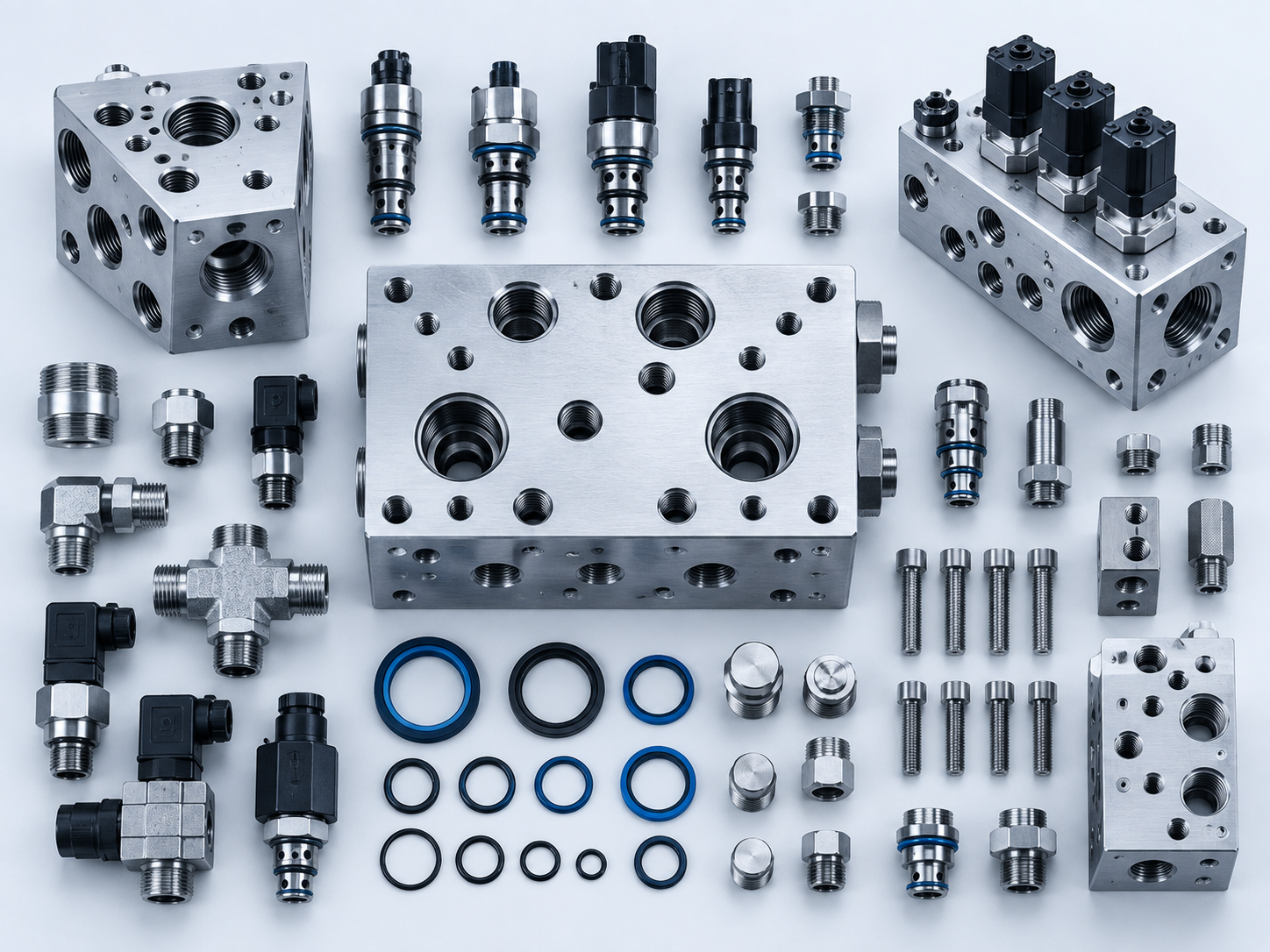
Engineering
Compact Manifold Design Factors
Applications
Where Compact Pneumatic Manifolds Are Used
Compact manifolds can be used in robotic tooling, assembly machines, packaging equipment, inspection systems, control enclosures, production fixtures, and other automated equipment with limited space.
They can also be positioned close to actuators, reducing tubing distance between the control valve and the pneumatic device.