
An air manifold provides multiple compressed-air connections from a common supply. Simple designs can function as distribution blocks, while larger pneumatic systems can use manifolds alongside valves, regulators, gauges, sensors, and actuator circuits.
Bringing several outlets together can simplify pneumatic plumbing and create a clear connection point between the main compressed-air supply and the individual machine functions using that air.
Air Distribution
How an Air Manifold Distributes Compressed Air
A main inlet connects the manifold to the compressed-air source. An internal chamber or passage communicates with several outlet ports, allowing one supply to serve multiple branches.
Each branch can feed a valve, cylinder, air tool, blow-off device, actuator, regulator, or another section of the pneumatic system.

Some outlets may operate continuously while others are used only during certain machine cycles. Total air demand therefore depends on both the connected devices and how frequently they operate together.
Air Supply
Connecting the Manifold to an Air Compressor
The manifold does not create compressed air. It distributes air supplied by a compressor and the upstream pneumatic system.
The available pressure and flow at the manifold depend on compressor capacity, receiver storage, regulators, filters, piping, hoses, fittings, and the combined demand of the connected equipment.
Industrial air compressors can supply larger pneumatic networks in which one or more manifolds divide the available air among machines or control circuits.
Ports & Fittings
Air Manifold Connections
Air manifold ports provide attachment points for pneumatic tubing, hoses, fittings, valves, gauges, regulators, and other components.
Port location should allow enough clearance for fittings and tubing while keeping the manifold accessible during installation and maintenance.
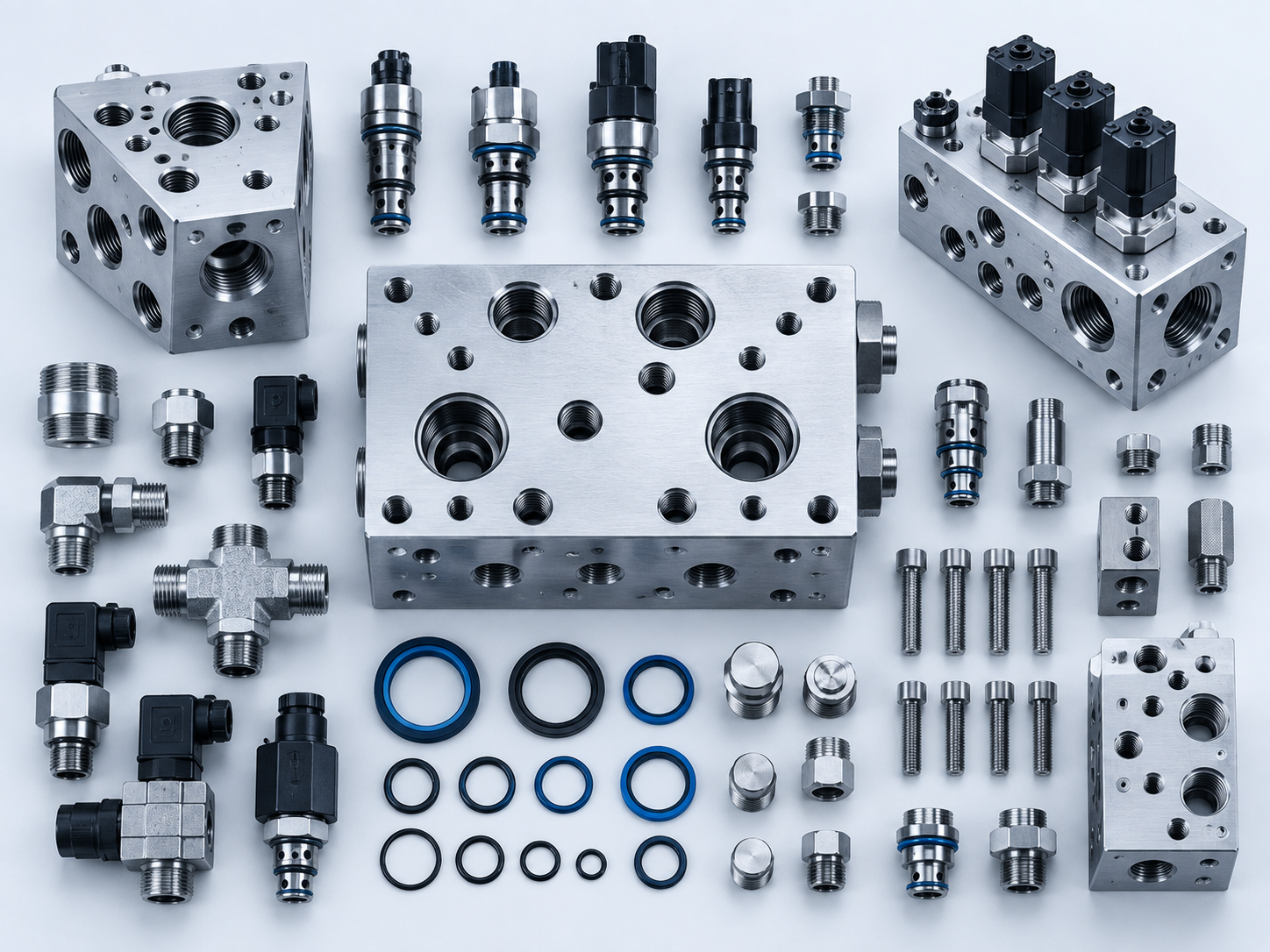
Unused ports may be closed with suitable plugs when the manifold includes more outlets than the system currently requires.
Airflow
Sizing an Air Manifold
The inlet, internal passage, and outlet sizes all influence how easily compressed air can move through the manifold.
A manifold serving several high-demand devices may require larger passages than one supplying small actuators that operate intermittently.
Restrictions can cause pressure at the outlet to fall when airflow demand increases. Sizing should therefore consider the total expected demand rather than only the nominal operating pressure.
Explore Pneumatic Manifold Sizing →Actuators
Supplying Pneumatic Cylinders
Air manifolds can distribute supply air toward directional valves serving pneumatic cylinders. The valve controls which side of the cylinder receives pressure and which side exhausts.
Dedicated pneumatic air cylinders are used throughout automated equipment to create linear motion from compressed air.
Cylinder bore, stroke, operating pressure, cycle frequency, and movement speed all influence how much air the actuator requires.
Design
Air Manifold Design Considerations
Applications
Air Manifold Applications
Air manifolds can supply automated tooling, cylinders, pneumatic clamps, grippers, blow-off stations, instrumentation, assembly equipment, packaging machinery, and many other pneumatic devices.
Simple manifolds can distribute air without containing control valves, while more sophisticated systems may place the manifold immediately upstream of a pneumatic valve bank.