
Aluminum and stainless steel are prominent manifold materials, but they are not the only metals available. Brass and carbon steel can also serve useful roles in industrial fluid-control systems depending on pressure, fluid compatibility, mechanical requirements, weight, corrosion exposure, and manufacturing needs.
Material selection should account for both the manifold block and the fittings, valves, plugs, tubing, seals, and other components that connect to it.
Nonferrous Materials
Brass Manifold Components
Brass is used throughout fluid-control equipment for fittings, valve bodies, connectors, adapters, and certain manifold components.
It can provide useful machinability and corrosion behavior in compatible fluid and environmental conditions.
Broader information about copper, brass, and bronze provides additional context for the family of nonferrous materials used throughout industrial piping and fluid-control equipment.
Information specifically covering brass can also help place this material within the larger copper-alloy family.
High-Strength Construction
Steel Manifold Blocks
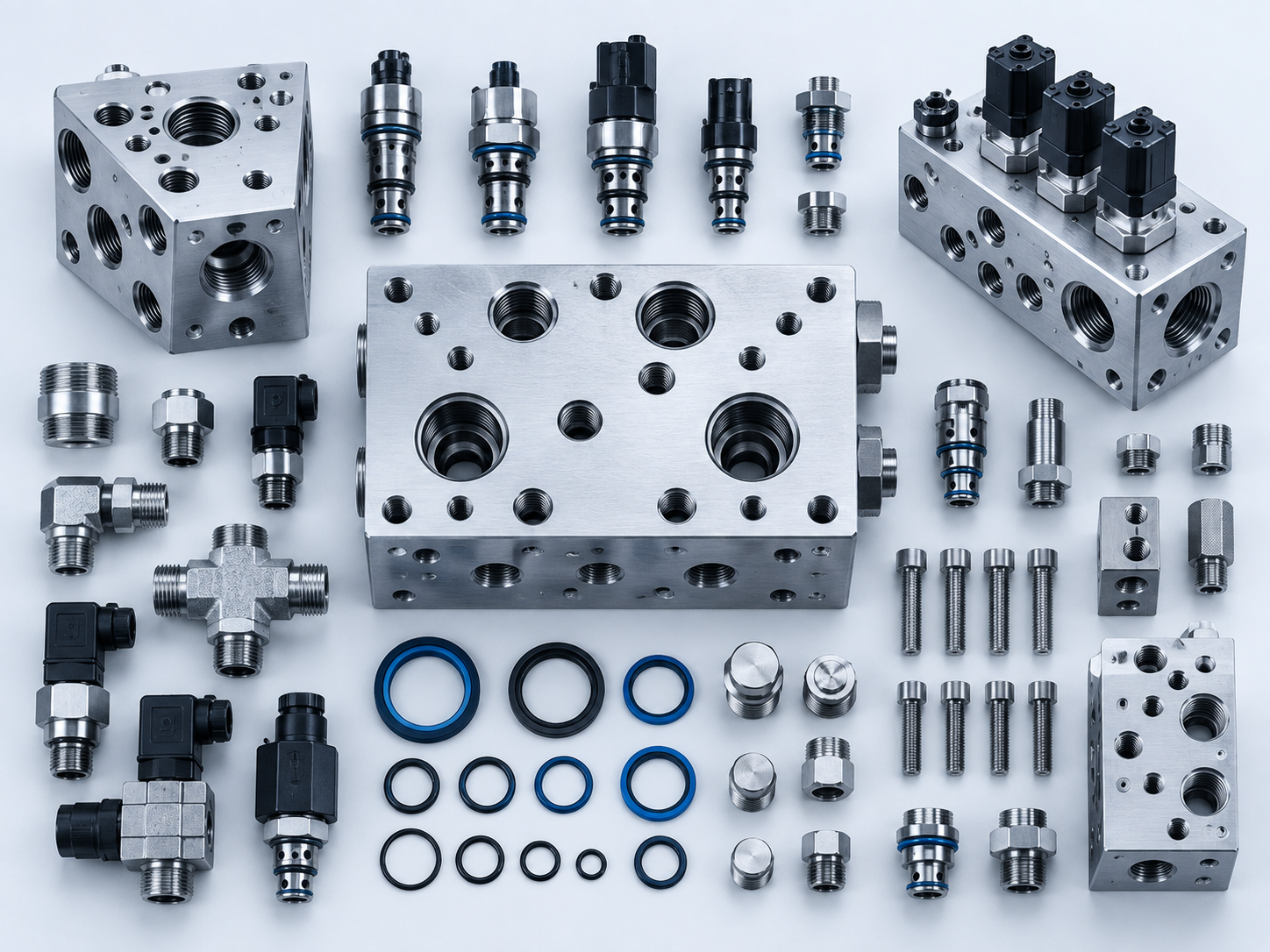
Steel can be selected for manifolds where mechanical strength and pressure capability are important design considerations.
The finished block can contain drilled passages, cartridge cavities, threaded ports, mounting features, sealing surfaces, and plugged machining openings in much the same way as other metallic manifold materials.
Industrial steel service centers supply and process many steel products used by manufacturers, while carbon steel represents a broad material category used in industrial fabrication and machining.
Pressure
Steel Manifolds for Demanding Pressure Systems
Higher material strength can be valuable in pressure-containing components, but the material alone does not determine the pressure capability of a manifold.
Internal passage diameter, spacing between holes, threads, valve cavities, wall thickness, plugs, block dimensions, and local stress conditions all influence the finished design.
Pressure-critical manifolds therefore require consideration of both the material properties and the complete machined geometry.
High-Pressure Hydraulic Manifolds →Machining
CNC Machining Brass and Steel
Different metals respond differently to drilling, milling, tapping, boring, and other machining operations.
Tool selection, cutting speed, workholding, lubrication, chip formation, heat, and required surface finish can all vary according to the selected material.

Manifold machining also requires attention to deep internal drilling and passage intersections, regardless of whether the block is brass, steel, aluminum, or stainless steel.
Custom Manifold CNC Machining →Corrosion
Environmental and Fluid Compatibility
Material performance depends on the fluid inside the manifold as well as the environment surrounding the component.
Moisture, process chemicals, outdoor exposure, washdown, temperature, cleaning agents, and dissimilar metals can all influence corrosion behavior.
Coatings, plating, conversion treatments, protective oils, or other surface treatments may be considered for some materials where additional surface protection is required.
Manifold Surface Finishes →Engineering
Brass and Steel Manifold Selection Factors
Comparing Materials
Brass, Steel, Aluminum or Stainless?
No single manifold material is ideal for every system. Aluminum can reduce weight and support efficient machining. Stainless steel can offer corrosion resistance. Steel can provide strength, while brass can be useful in compatible valve, fitting, and manifold applications.
The final choice should reflect pressure, fluid compatibility, corrosion, machining, weight, cost, service life, and surrounding equipment.