
Ball valves use a rotating spherical closure element containing a flow opening. Turning the ball aligns or misaligns that opening with the valve ports, allowing the valve to provide rapid shutoff or redirect fluid through alternate connections.
When several ball valves are grouped into a manifold, the assembly can control multiple lines from one organized location while reducing the amount of independent valve mounting and external connection hardware.
Rotary Operation
How Ball Valves Control Flow
A basic ball valve contains a bore through the center of its spherical closure element. When the bore aligns with the inlet and outlet, fluid can pass through the valve.
Rotating the ball approximately one-quarter turn moves the solid portion of the ball across the passage and stops the flow.
Additional information about industrial ball valves can provide broader context for the rotary valve technology incorporated into manifold systems.
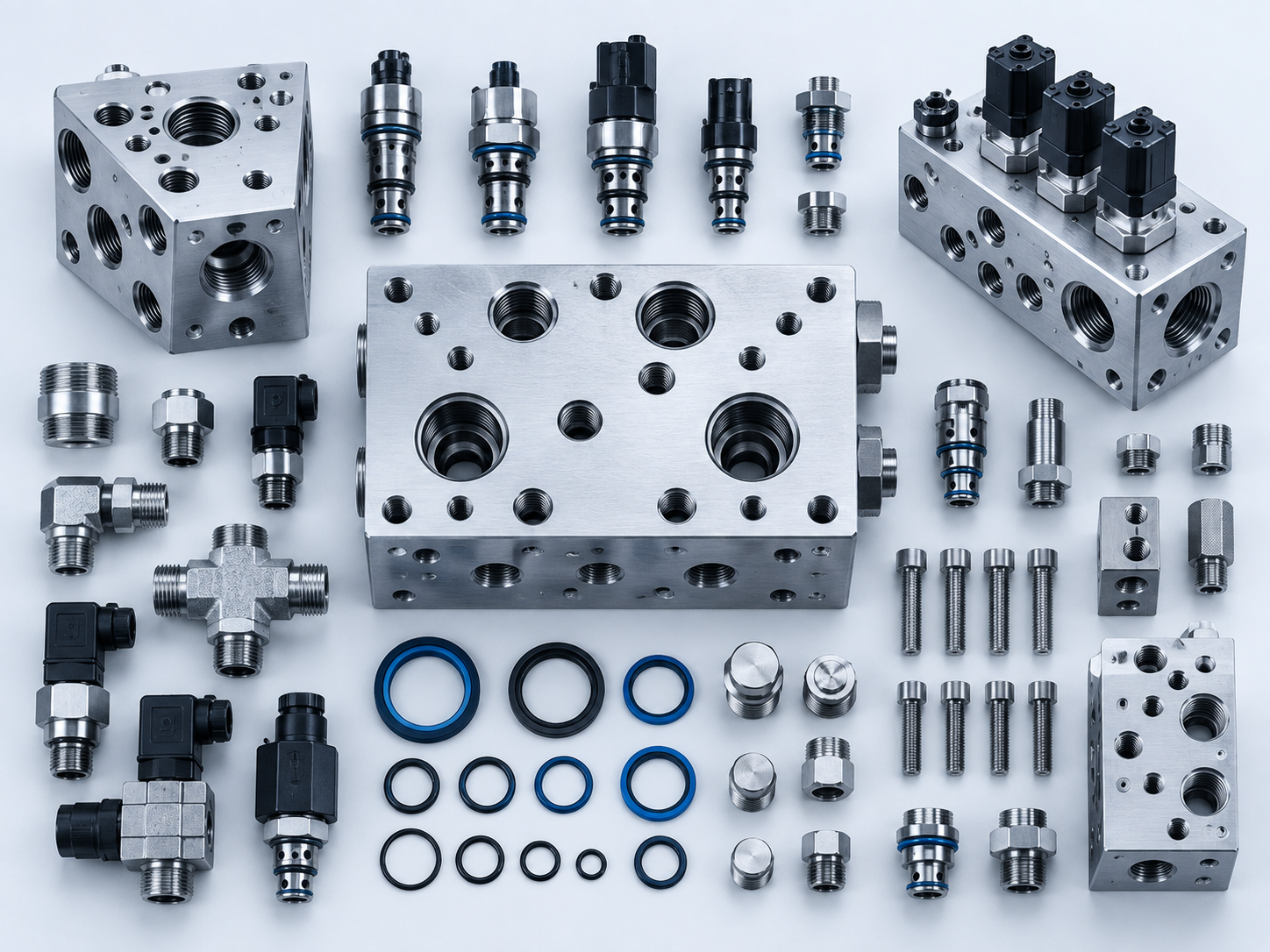
Isolation
Ball Valves for Manifold Isolation
Isolation valves allow individual process lines, instruments, equipment branches, or fluid circuits to be separated from the rest of the system.
Placing several isolation valves together can make it easier to identify and control related fluid connections from one manifold assembly.
The required sealing performance depends on pressure, temperature, media, seat material, valve construction, and operating conditions.
Flow Routing
Three-Way and Multi-Port Ball Valves
A ball valve does not have to provide only simple on/off control. Multi-port designs can connect several fluid paths using one rotary closure element.
Industrial 3-way ball valves can be configured to select between alternate flow paths, combine streams, or redirect a supply toward different manifold branches.
The internal bore geometry of the ball determines which ports communicate at each operating position.

Actuation
Manual and Automated Ball Valve Manifolds
Ball valves can be operated manually with handles or connected to mechanical, pneumatic, or electric actuators.
Manual operation can be suitable for maintenance isolation and infrequently changed process connections. Automated actuation can be useful when valves need to respond to process logic, remote commands, or machine sequences.
Actuator size and mounting should correspond with the torque required to rotate the valve under operating conditions.
Sealing
Ball Seats, Stem Seals and Media Compatibility
Ball valves rely on sealing surfaces around the ball as well as seals around the valve stem and body connections.
Seat and seal materials should be compatible with the controlled fluid, temperature, pressure, cleaning methods, and operating environment.

Engineering
Ball Valve Manifold Design Factors
Applications
Ball Valve Manifold Applications
Ball valve manifolds can be used for process isolation, instrumentation connections, fluid distribution, test equipment, sampling systems, hydraulic circuits, gas handling, and other industrial applications.
The configuration can range from several simple shutoff valves to multi-port systems capable of switching between different fluid paths.